Even though we may consider fabric to be a finished material, there is more to it than meets the eye. Before you can analyze the weave or knit structure of a textile, there are fibers. These fibers have to be prepared, spun into yarn, and then formed into fabric. Breaking down this sequence helps us understand textile production by connecting the concepts in an accessible and practical manner. Rather than focusing solely on the terms, it is more helpful to view these operations as steps in a chain.
First, we start with the fiber. These fibers may vary in length depending on the source, ranging from short, staple fibers to longer filaments. To prepare these fibers for spinning, we can perform operations such as carding or combing. Carding separates the fibers from one another, and combs can be used to further align them. Even though we haven’t made fabric yet, certain aspects of the fiber (such as its length and fineness) will play a role in how it is processed throughout the chain.
Next, we take these fibers and turn them into yarn. By twisting the fibers together, we create yarn. It is important to note that two pieces of yarn might look the same to the naked eye, but upon closer inspection, they may have varying degrees of thickness, twist, and smoothness. Examining a few different types of yarn will help reinforce these distinctions. Using a magnifying glass will help you see even the smallest inconsistencies in the yarn, and give you a better idea of what to look for.
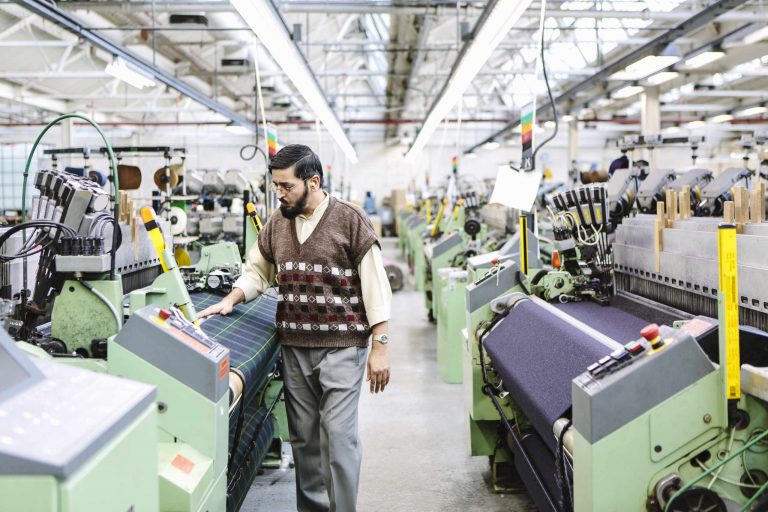
Finally, we turn our attention to the fabric. Fabrics are formed when yarns are interlaced together in various ways. For example, in a woven fabric, we have warp yarns running along the length of the fabric, and weft yarns interlacing with them across the width. Different combinations of warp and weft yield different structures, such as the plain weave and twill. In a knitted fabric, we instead have loops of yarn linked together rather than repeated warp-and-weft intersections. If you place a woven swatch side-by-side with a knitted swatch and try to pull them apart, you will see that the woven fabric does not have the same give as the knitted fabric.
When you examine the two swatches under good light, you will notice that the woven fabric has distinct warp and weft yarns, whereas the knitted fabric is composed of interlinked loops. The distinction between woven and knitted fabrics is much more apparent when observed visually, rather than relying on a verbal description.
There are many different types of fabric structures, and there is no reason to assume all fabrics are finished once the weaving or knitting is complete. Depending on the type of fabric, we may apply a variety of finishes, including dyeing, printing, washing, heat setting, and coating, among others. These finishes can alter the appearance of the fabric, as well as its performance. For example, a finishing treatment might be applied to a fabric to improve its dimensional stability, or to change its hand-feel and drape. It is crucial to consider finishing as part of the production chain, rather than merely a finishing touch after the fabric is made.
One effective way to explore the entire chain is to select a piece of fiber, yarn, and fabric. Examine each stage in turn, describing what has happened to transform the fiber into a yarn, and the yarn into a fabric. Focus on the yarns that make up the fabric, and whether it is constructed of warp and weft yarns (in the case of a woven fabric), or of interlinked loops (for a knitted fabric). Consider the density of the construction, the texture of the surface, and whether there are any visible imperfections. By comparing these materials repeatedly, you will develop an intuitive sense of the chain, allowing you to identify the fiber-to-fabric chain directly from the materials themselves.